

I. INTRODUCTION
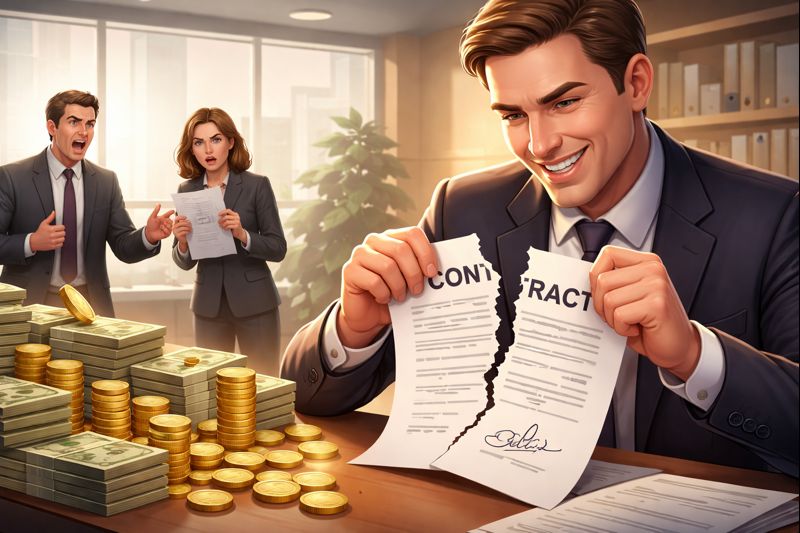
In traditional contract law theory, breach of contract is commonly perceived as a negative phenomenon, arising from bad faith, lack of performance capacity, or objective circumstances beyond the parties’ control. However, in the context of a modern market economy—particularly in high-value commercial transactions—an increasingly notable phenomenon has emerged: enterprises deliberately, strategically, and consciously anticipate legal consequences in order to breach contracts for the purpose of optimizing economic benefits.
II. THE CONCEPT AND LEGAL NATURE OF “INTENTIONAL” CONTRACT BREACH BY ENTERPRISES
1. The Concept from a Business Practice Perspective
Vietnamese law does not formally recognize terms such as “intentional breach of contract” or “strategic breach.” Nevertheless, in business practice, these terms are commonly used to describe situations in which a contracting party:
- clearly understands its contractual obligations;
- anticipates in advance the legal sanctions it may incur;
- compares the economic benefits gained from non-performance with the legal costs of breach; and
- deliberately chooses to breach the contract because the expected economic gain outweighs the legal consequences.
This type of conduct is fundamentally different from breaches caused by force majeure, fundamental changes of circumstances, or mere negligence.
2. The Approach of Vietnamese Civil Law
Pursuant to Article 351 of the 2015 Civil Code, a party that breaches an obligation must bear civil liability, unless liability is exempted by law. This provision reflects a consequence-based approach: the law focuses on the existence of a breach rather than on the breaching party’s motive.
Similarly, Article 302 of the 2005 Commercial Law establishes liability for damages in commercial contracts without distinguishing between negligent breaches and intentional breaches. From a normative standpoint, therefore, intentional breaches are not treated differently from ordinary contractual breaches under Vietnamese law.
III. CIVIL LIABILITY MECHANISMS APPLICABLE TO INTENTIONAL BREACHES
1. Liability for Damages
Under Article 360 of the 2015 Civil Code, upon breach of an obligation, the breaching party must compensate for all damages, unless otherwise agreed or provided by law. In the commercial context, Article 302 of the 2005 Commercial Law provides that compensable damages include:
- actual, direct losses; and
- direct profits that the aggrieved party would have obtained had the breach not occurred.
In judicial practice, however, proving damages and lost profits is often difficult, particularly in complex commercial transactions. As a result, the actual compensation imposed on the breaching party is frequently lower than the economic benefits obtained through the breach.
2. Contractual Penalties
According to Article 418 of the 2015 Civil Code, contractual penalties are imposed only if agreed upon by the parties. In commercial contracts, Article 301 of the 2005 Commercial Law caps penalties at no more than 8% of the value of the breached contractual obligation.
This limitation aims to protect freedom of contract and prevent abuse of penalty clauses. However, in situations where enterprises can strategically calculate costs and benefits, the 8% cap may lack sufficient deterrent effect—especially in contracts with high profit margins or significant market volatility.
3. The Role of Fault in Contractual Liability
Vietnamese law does not differentiate contractual liability based on degrees of fault. This leads to a legal paradox: negligent breaches and intentional breaches may be subject to the same sanctions if the resulting damages are comparable.
While this approach aligns with the principle of pure compensatory liability, it fails to adequately reflect the heightened social harm posed by intentional breaches in a commercial environment.
IV. ACADEMIC AND JUDICIAL ASSESSMENT
1. Does Current Law “Tolerate” Strategic Breach?
It may be argued that Vietnamese contract law prioritizes restoring contractual balance rather than punishing breaches. In this context, enterprises may view contract breach as a legitimate business option when legal costs are relatively low.
This raises concerns about eroding market confidence in the binding force of contracts—a cornerstone of legal certainty in commercial transactions.
2. Judicial Practice
In practice, courts generally:
- do not examine the motive behind the breach;
- do not treat intentional breach as an aggravating factor;
- focus primarily on evidence of damages and contractual terms.
While this approach ensures objectivity, it also results in intentional breaches not being recognized as a distinct legal issue warranting special scrutiny.
V. RECOMMENDATIONS FOR LEGAL REFORM
First, contractual freedom regarding sanctions in commercial contracts should be expanded, particularly for parties with equal bargaining power and high-value transactions.
Second, greater emphasis should be placed on the principles of good faith and honesty under Articles 3 and 6 of the 2015 Civil Code, treating intentional breach for unjust enrichment as an abuse of civil rights.
Third, in the long term, comparative legal studies should be conducted to explore more flexible sanctioning mechanisms, allowing courts to consider fault in particularly serious breach cases.
VI. CONCLUSION
The phenomenon of enterprises intentionally breaching contracts to optimize economic benefits reflects a collision between market logic and legal logic. While Vietnamese contract law has established a relatively comprehensive liability framework, it remains limited in deterring strategic breaches. Improving the law to ensure fairness, enhance predictability, and reinforce trust in contractual commitments is an inevitable requirement in the ongoing development of Vietnam’s market economy.
📞 CONTACT LEGAL CONSULTANT:
TLA Law is a leading law firm with a team of highly experienced lawyers specializing in criminal, civil, corporate, marriage and family law, and more. We are committed to providing comprehensive legal support and answering all your legal questions. If you have any further questions, please do not hesitate to contact us.
1. Lawyer Vu Thi Phuong Thanh, Ha Noi Bar Association
Email: vtpthanh@tlalaw.vn
2. Lawyer Tran My Le, Ha Noi Bar Association
Email: tmle@tlalaw.vn
Khuong Ngoc Lan