

I. INTRODUCTION
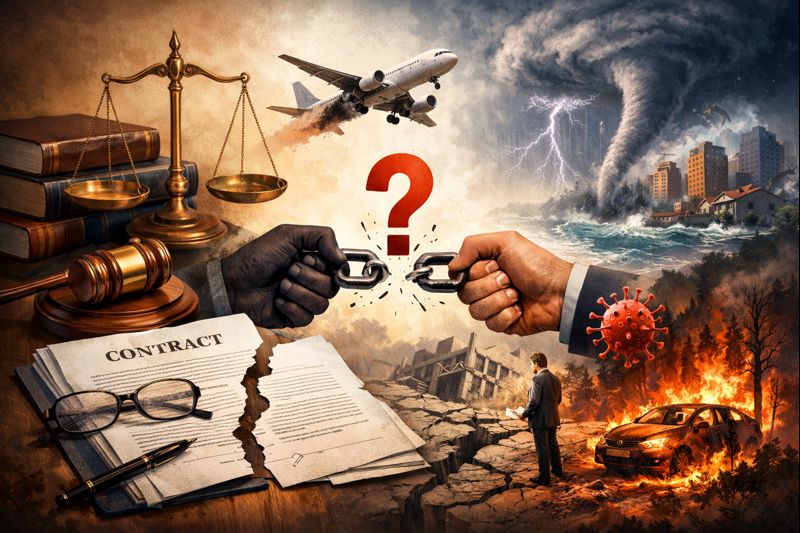
In civil and commercial contractual relationships, the failure to perform or the improper performance of contractual obligations by one party is the primary cause of disputes. As a matter of principle, the party in breach must bear legal liability toward the other party. However, the law does not absolutize such liability; instead, it recognizes certain exceptions in order to ensure fairness, among which the most notable is breach caused by force majeure events. Properly identifying the nature of force majeure events and their legal consequences is of significant importance in legal practice, particularly in the context of civil and commercial transactions that are increasingly affected by objective and uncontrollable factors.
II. CONCEPT AND CONDITIONS FOR DETERMINING A FORCE MAJEURE EVENT
1. Concept of force majeure
Clause 1, Article 156 of the 2015 Civil Code provides:
“A force majeure event is an event that occurs objectively, is unforeseeable, and cannot be remedied despite the application of all necessary and permissible measures.”
Accordingly, a force majeure event is understood as an event that lies beyond the subjective will of the parties, could not be reasonably foreseen at the time of contract formation, and exceeds the control capacity of the obligor.
2. Conditions for determining a force majeure event
For an event to be considered force majeure, it must simultaneously satisfy three mandatory conditions.
First, the event must be objective in nature, meaning that it does not arise from the fault or subjective conduct of the breaching party.
Second, the event must be unforeseeable in a reasonable manner at the time the contract was concluded.
Third, the consequences of the event must be unavoidable, even though the breaching party has applied all necessary and feasible measures.
The absence of any one of these three conditions will result in the event not being recognized as force majeure under the law.
III. PRINCIPLES OF LIABILITY FOR BREACH OF CONTRACTUAL OBLIGATIONS
1. General principle
Pursuant to Article 351 of the 2015 Civil Code, a party that breaches its contractual obligations must bear civil liability toward the entitled party. Such liability includes compensation for damages, contractual penalties, and other legal consequences as agreed by the parties or prescribed by law.
2. Exception in the event of force majeure
Clause 2, Article 351 of the 2015 Civil Code stipulates that a breaching party shall not bear civil liability if the breach is caused by a force majeure event, unless otherwise agreed by the parties or otherwise provided by law. This provision demonstrates that force majeure constitutes a ground for exemption from liability; however, such exemption is not automatic and must be proven on a case-by-case basis.
IV. SCOPE OF EXEMPTION FROM LIABILITY IN THE EVENT OF FORCE MAJEURE
1. Types of liabilities exempted
When a force majeure event occurs, the breaching party may be exempted from liability for damages and from contractual penalties, unless otherwise agreed in the contract. Such exemption is limited to liabilities arising from the breach of obligations and does not extinguish the contractual obligations themselves if their performance remains possible.
2. Impact of force majeure on the validity of the contract
A force majeure event does not automatically terminate a contract. In many cases, contractual obligations are merely suspended during the occurrence of the force majeure event and shall resume once the event ceases. Only when the force majeure event persists and renders the contractual purpose unattainable may the contract be terminated in accordance with the law.
V. BURDEN OF PROOF AND THE OBLIGATION TO MITIGATE DAMAGES
1. Burden of proving force majeure
In the event of a dispute, the party breaching the contract bears the burden of proving the existence of a force majeure event in accordance with the conditions stipulated in Article 156 of the 2015 Civil Code. At the same time, such party must prove the direct causal relationship between the force majeure event and the failure or improper performance of the contractual obligations.
2. Obligation to mitigate damages
In addition to the burden of proof, the breaching party must demonstrate that it has applied all necessary and reasonable measures to limit the damages incurred. Failure to fulfill this obligation may result in the denial of exemption from liability or only a partial exemption.
VI. DIFFERENCES BETWEEN CIVIL LAW AND COMMERCIAL LAW
According to Clause 1, Article 294 of the 2005 Law on Commerce, a party breaching a contract is exempted from liability in the event of force majeure. Compared to the Civil Code, commercial law places greater emphasis on the obligation to promptly notify the other party of the occurrence of the force majeure event and on the obligation to apply necessary measures to minimize losses. This approach reflects the specific characteristics of commercial relationships, which demand a high level of professionalism, good faith, and responsibility in business activities.
VII. DISTINGUISHING FORCE MAJEURE FROM FUNDAMENTAL CHANGE OF CIRCUMSTANCES
It is necessary to clearly distinguish force majeure from a fundamental change of circumstances under Article 420 of the 2015 Civil Code. A force majeure event renders the performance of contractual obligations impossible, whereas a fundamental change of circumstances merely makes performance excessively disadvantageous to one party. In cases of a fundamental change of circumstances, the affected party is not exempted from liability but is entitled to request renegotiation of the contract or to request the court to resolve the matter in accordance with the law.
VIII. CONCLUSION
Force majeure is an important legal institution aimed at ensuring fairness in contractual relationships by relieving the breaching party of legal liability in objective circumstances beyond its control. However, the application of this institution must be conducted strictly, based on a comprehensive assessment of statutory conditions and factual evidence. To minimize disputes, parties should clearly stipulate force majeure events, the scope of liability exemption, notification obligations, and legal consequences when entering into contracts. This not only enhances legal certainty for civil and commercial transactions but also ensures the stability and sustainability of contractual relationships in practice.
📞 CONTACT LEGAL CONSULTANT:
TLA Law is a leading law firm with a team of highly experienced lawyers specializing in criminal, civil, corporate, marriage and family law, and more. We are committed to providing comprehensive legal support and answering all your legal questions. If you have any further questions, please do not hesitate to contact us.
1. Lawyer Vu Thi Phuong Thanh, Ha Noi Bar Association
Email: vtpthanh@tlalaw.vn
2. Lawyer Tran My Le, Ha Noi Bar Association
Email: tmle@tlalaw.vn
Khuong Ngoc Lan