

Introduction
In the context of international economic integration, the export activities of Vietnamese enterprises have increasingly developed, contributing significantly to GDP growth and improving the trade balance. However, during the export process, Vietnamese enterprises must not only comply with domestic regulations but also adhere to the technical standards and regulations of the importing country.
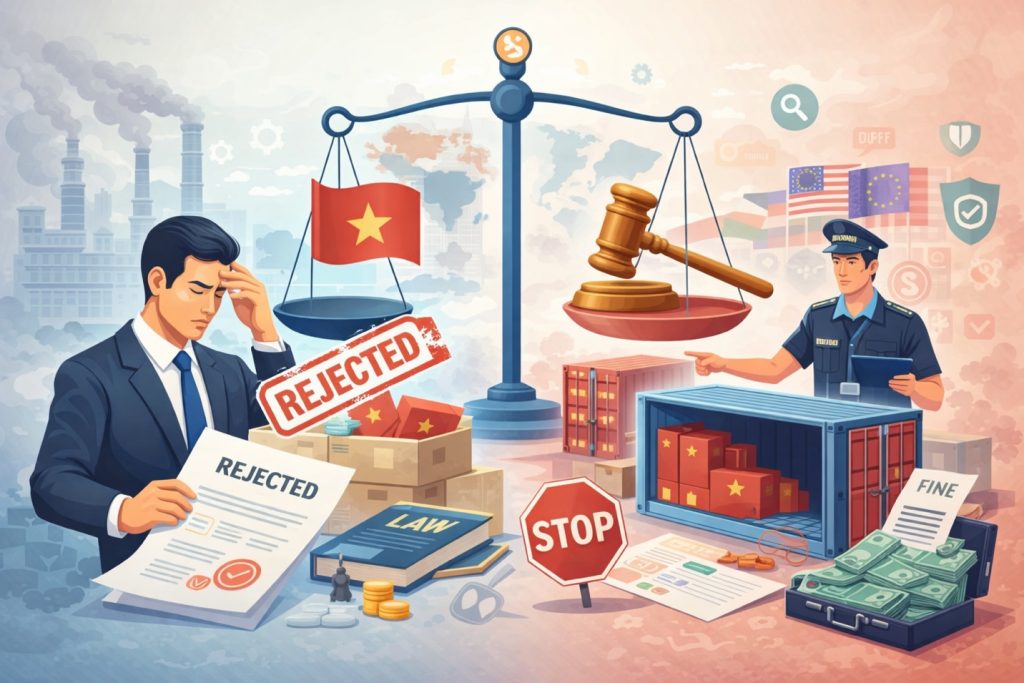
A practical legal issue that frequently arises is the return of exported goods due to non-compliance with foreign standards, which may result in economic losses, contract disputes, and legal liability. This study analyzes the legal basis, scope of liability of Vietnamese enterprises, the rights and obligations of parties in export contracts, and proposes solutions to reduce legal risks.
I. Legal Basis for Exported Goods
- Commercial Law 2005 (amended 2020)
- Article 28: Fundamental principles of commercial contracts – parties must properly perform agreements, ensure product quality, delivery time, and other contractual conditions.
- Article 68: Seller’s liability in international sale contracts – the seller must deliver goods in accordance with the agreed quality, quantity, packaging, labeling, and applicable standards.
- Law on Product and Goods Quality 2007 (amended 2017)
- Article 7: Enterprises must ensure that exported products comply with the technical standards and regulations applicable to the importing market.
- Article 18: Liability for non-compliant products constitutes grounds for administrative handling or compensation under contract provisions.
- Export Guidance Documents
- Circular 41/2018/TT-BCT: Guidance on exporting agricultural and food products, including quality inspection and certification of conformity.
- Regulations on certificate of origin, quality inspection, packaging, and labeling according to the requirements of the importing country.
II. Legal Liability of Vietnamese Enterprises When Goods Are Returned
1. Contractual Liability
- When exported goods fail to meet foreign standards and are returned, Vietnamese enterprises may be held liable for breach of contract.
- Under Article 301 of the Civil Code 2015, enterprises must compensate for damages caused by contract breach, including:
- Return shipping costs.
- Losses due to delayed delivery or missed business opportunities.
- Costs of storage, preservation, or disposal of goods (if applicable).
Practical example: A Vietnamese food exporter ships products to the EU, but they do not meet EU food hygiene standards. The goods are returned, and the enterprise bears all shipping costs and contractual penalties.
2. Legal Liability under Technical Standards
- Enterprises must ensure that goods meet import standards (e.g., HACCP, ISO, Codex Alimentarius).
- Violation of these standards may result in enforcement under Article 12 of the Law on Product and Goods Quality, including:
- Administrative fines.
- Revocation of licenses or suspension of export activities.
- Compensation for losses to foreign partners.
- Additionally, enterprises may face claims in foreign courts if the contract specifies foreign law or international arbitration.
3. Coordinated Responsibilities with Relevant Parties
- Banks: In international payments, enterprises must ensure export documents comply with requirements to avoid Letter of Credit (LC) disputes.
- Vietnamese quality inspection authorities: Provide certificates of conformity and compliance.
- Foreign customers: Enterprises must clearly communicate standards, labeling, and expiration dates before shipment.
4. Solutions to Reduce Risks
- Detailed contracts: Specify applicable standards, delivery conditions, and procedures for returned goods.
- Ensure quality certification: Present conformity certificates and conduct internal inspections before export.
- Export insurance: Mitigate losses in case of returned goods.
- Agreement on governing law and arbitration: Avoid prolonged legal disputes in case of incidents.
III. Conclusion
The legal liability of Vietnamese enterprises when exported goods are returned due to foreign standards is a complex issue, including:
- Contractual liability under Article 28 of the Commercial Law 2005 and Article 301 of the Civil Code 2015.
- Compliance liability under technical standards and regulations according to the Law on Product and Goods Quality 2007.
- Coordination with banks, inspection agencies, and customers to minimize damages.
Understanding the legal basis, drafting detailed contracts, ensuring quality certification, and implementing preventive measures help enterprises reduce legal risks and protect their reputation in the international market. At the same time, the law should continue to be improved to facilitate exports while safeguarding the rights of foreign partners.
📞 CONTACT LEGAL CONSULTANT:
TLA Law is a leading law firm with a team of highly experienced lawyers specializing in criminal, civil, corporate, marriage and family law, and more. We are committed to providing comprehensive legal support and answering all your legal questions. If you have any further questions, please do not hesitate to contact us.
1. Lawyer Vu Thi Phuong Thanh, Ha Noi Bar Association
Email: vtpthanh@tlalaw.vn
2. Lawyer Tran My Le, Ha Noi Bar Association
Email: tmle@tlalaw.vn
Khuong Ngoc Lan