

I. Introduction
In the context of current socio-economic development, land use rights are not only valuable assets but also a frequent source of complex legal disputes, particularly in the field of inheritance. One common situation arises when a deceased person leaves no will, leading to the application of intestate succession, which entails various legal consequences concerning the disposition of assets.
II. Legal Basis
- Civil Code 2015
- Article 609: Right to inheritance
- Article 650: Intestate succession
- Article 651: Heirs at law
- Article 660: Distribution of the estate
- Land Law 2013
- Article 167: Rights to transfer and donate land use rights
- Article 188: Conditions for exercising the rights of land users
- Law on Notarization 2014
- Provisions on notarization of agreements on division of inherited estate
III. Legal Analysis
1. Determination of the Estate and Heirs
Pursuant to Article 650 of the Civil Code 2015, where Mr. K dies without leaving a will, the estate shall be distributed according to law (intestate succession).
Under Article 651 of the Civil Code 2015:
“The first line of heirs comprises the spouse, parents, and children of the deceased.”
In this case:
- Mrs. T (wife)
- Five children (A, B, C, D, E)
Thus, there are a total of six heirs in the first line of succession.
According to the principle:
“Heirs of the same rank are entitled to equal shares of the estate.”
→ Each person is entitled to 1/6 of the estate value (if the entire land is the separate property of Mr. K).
2. Determination of the Nature of the Property: Separate or Marital Property
This is a crucial issue that must be clarified:
- If the land use right is Mr. K’s separate property:
→ The entire land value constitutes the estate → divided equally among six heirs - If it is marital (joint) property:
→ Apply the principles of the Law on Marriage and Family:- Mrs. T owns 1/2 of the property
- The remaining 1/2 constitutes the estate
→ In this case, A’s share will be smaller (not 1/6 of the entire land).
3. Legal Nature of Land Use Rights After the Opening of Succession
After Mr. K’s death but before the estate is divided, the land use right becomes:
→ Common property of co-heirs
Pursuant to Article 660 of the Civil Code 2015:
“The distribution of the estate shall be carried out by agreement among the heirs…”
Legal consequences:
- No individual has full authority to dispose of the property
- Any transaction relating to the land requires the consent of all co-heirs
4. Assessment of Child A’s Request
Child A has two demands:
- To build a house on the land
- To have the land use right registered under A’s name
a. Regarding house construction
Under the Land Law 2013 and construction regulations:
- The applicant for a construction permit must be the lawful land user
A is only a co-owner (partial interest holder)
→ A cannot unilaterally build a house without the consent of all co-heirs
b. Regarding land title registration
Under Article 167 of the Land Law 2013:
- The transfer of land use rights must be made in writing and notarized/certified
A may obtain title only if:
- Other co-heirs transfer or donate their shares to A; or
- There is a written agreement on estate division
5. Legal Procedures for A to Lawfully Obtain Title
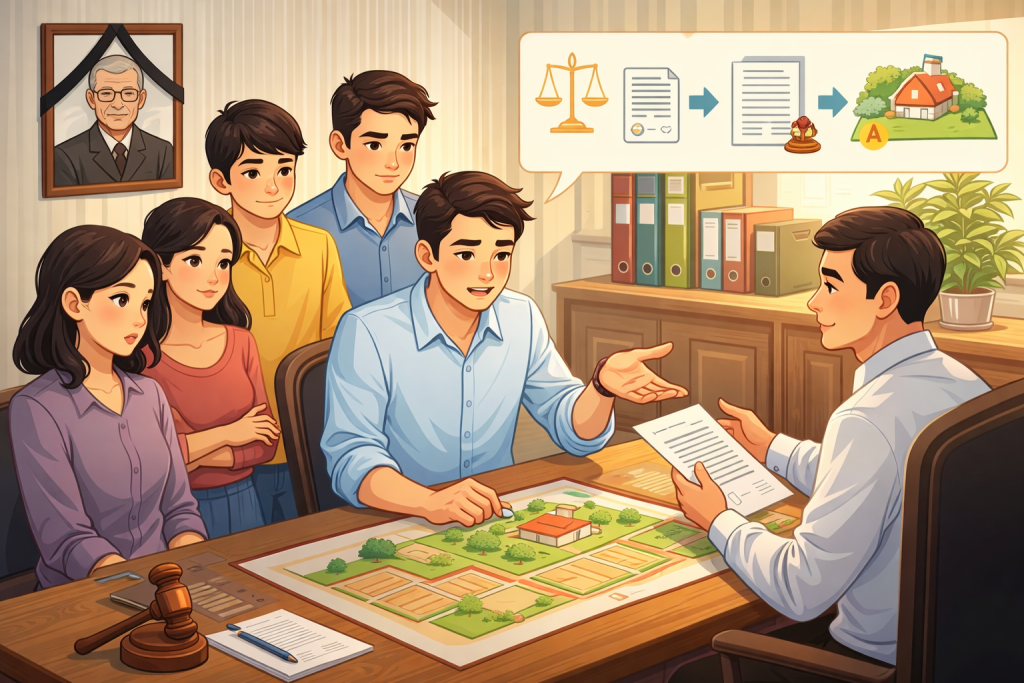
Step 1: Declaration or Agreement on Estate Division
The co-heirs must proceed at a notarization organization:
- Prepare a Notarized Agreement on Division of Estate
- Contents include:
- Agreement that A receives the entire land use right
- Remaining members consent to waive or transfer their shares
→ This is the most important and mandatory step
Step 2: Registration of Land Changes
Pursuant to Article 188 of the Land Law 2013:
After obtaining the notarized document, A shall:
- Submit the application to the Land Registration Office
- Carry out procedures for change of title (name transfer)
→ Result: A becomes the lawful land user
Step 3: Exercising Construction Rights
After being registered as the land user:
- A has the right to apply for a construction permit
- Proceed with building the house in accordance with the law
6. In Case No Agreement Is Reached
If the co-heirs cannot reach consensus:
Option 1: Division of the estate by law
- Each heir receives their respective share
- A cannot use the entire land
Option 2: Initiate a lawsuit in court
- Request the court to divide the estate
- A may receive the land in kind and compensate other heirs
IV. Conclusion
Where a deceased person leaves no will, the land use right becomes the common property of co-heirs under intestate succession. No individual, including child A, has the right to unilaterally dispose of the entire property unless the procedures for estate division have been duly completed.
📞 CONTACT LEGAL CONSULTANT:
TLA Law is a leading law firm with a team of highly experienced lawyers specializing in criminal, civil, corporate, marriage and family law, and more. We are committed to providing comprehensive legal support and answering all your legal questions. If you have any further questions, please do not hesitate to contact us.
1. Lawyer Vu Thi Phuong Thanh, Ha Noi Bar Association
Email: vtpthanh@tlalaw.vn
2. Lawyer Tran My Le, Ha Noi Bar Association
Email: tmle@tlalaw.vn
Khuong Ngoc Lan