

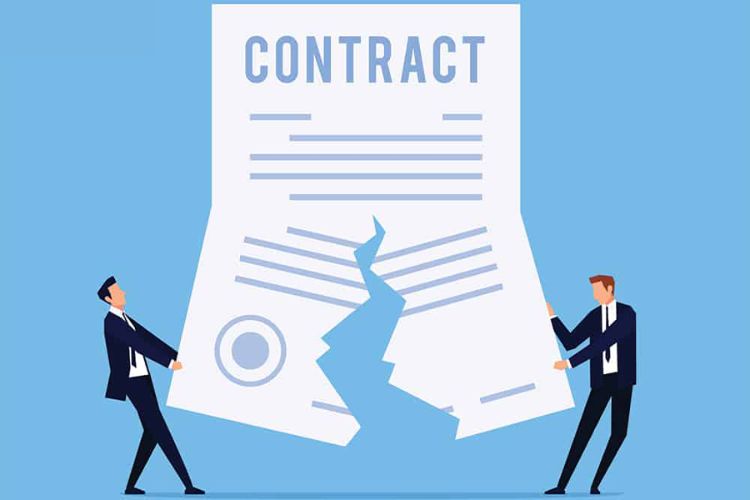
This section provides an overview of the legal framework and practical considerations that parties should keep in mind when resolving contractual disputes in Vietnam. Understanding governing laws, jurisdictional rules, limitation periods, and evidentiary obligations is essential for ensuring lawful, effective, and efficient dispute resolution.
- What Is a Contractual Dispute?
A contract is understood as an agreement between the parties regarding the establishment, modification, or termination of their respective rights and obligations. Accordingly, a contractual dispute refers to disagreements or conflicts arising between parties engaging in a contractual relationship.
Examples: disputes between a landlord and a tenant, disputes between a buyer and a seller, disputes between a deposit giver and a deposit receiver, etc.
- Key Notes on Resolving Contractual Disputes in Vietnam
- Governing Legal Framework
Vietnam’s legal system consists of multiple specialized legal branches, each regulating specific issues in society. Therefore, when resolving a dispute, the parties must identify the applicable legal framework to ensure optimal protection of their legitimate rights and interests.
Example:
Commercial disputes are governed primarily by the Commercial Law, as well as other relevant sector-specific laws such as the Law on Real Estate Business (for real estate transactions) and the Law on Construction (for construction contracts).
In addition to statutory regulations, contractual provisions and prior agreements or commitments between the parties during negotiation and performance also serve as legal grounds for dispute settlement.
- Jurisdiction for Resolving Contractual Disputes
Under current legislation, jurisdiction to resolve contractual disputes belongs to Courts or Commercial Arbitration, specifically as follows:
(i) Commercial Arbitration : Commercial arbitration has jurisdiction over contractual disputes arising from commercial activities. Furthermore, pursuant to Article 5 of the Law on Commercial Arbitration 2010, arbitration may only be selected if the parties have an agreement to resolve disputes by arbitration—whether agreed before or after the dispute arises.
(ii) Courts: According to Articles 35, 37, and 39 of the 2015 Civil Procedure Code, courts have jurisdiction to resolve contractual disputes in most areas, including civil, commercial, and labor disputes. When initiating a lawsuit, the claimant must file a statement of claim with the district-level People’s Court, or with a provincial-level People’s Court if the case involves foreign elements, where the defendant resides, works, or has its principal place of business.
- Statute of Limitations for Dispute Resolution
The statute of limitations is the period prescribed by law during which parties may request a competent authority to resolve a dispute. Upon expiration, the request may no longer be accepted. Specific timelines include:
(i) Statute of limitations for initiating court proceedings:
- Civil contracts: 03 years from the date on which the aggrieved party knew or should have known that its lawful rights and interests were infringed.
- Commercial contracts: 02 years from the time the lawful rights and interests are infringed.
- For certain other types of contracts, parties should refer to relevant specialized legislation.
(ii) Statute of limitations for arbitration: 02 years from the time the lawful rights and interests are infringed.
- Burden of Proof in Civil Proceedings
Pursuant to Article 91 of the Civil Procedure Code, when requesting the Court to resolve a dispute, each party must independently collect evidence and documents to prove that its claims are lawful.
Therefore, to adequately protect their rights and interests, individuals and organizations must provide sufficient legal grounds supporting their claims when requesting the Court to accept their demands.
In conclusion, resolving contractual disputes in Vietnam requires a thorough understanding of applicable laws, jurisdictional mechanisms, limitation periods, and evidentiary responsibilities. Proper preparation, precise identification of governing regulations, and strict compliance with procedural requirements are essential for safeguarding rights and achieving efficient dispute resolution. Parties are encouraged to document agreements clearly, maintain supporting evidence, and seek professional legal advice when necessary to minimize risks and improve dispute-resolution outcomes.
📞 CONTACT LEGAL CONSULTANT:
TLA Law is a leading law firm with a team of highly experienced lawyers specializing in criminal, civil, corporate, marriage and family law, and more. We are committed to providing comprehensive legal support and answering all your legal questions. If you have any further questions, please do not hesitate to contact us.
1. Lawyer Vu Thi Phuong Thanh, Chairman of the Members’ Council, Ha Noi Bar Association
Email: vtpthanh@tlalaw.vn
2. Lawyer Tran My Le, Manager of TLA Law LLC, Ha Noi Bar Association
Email: tmle@tlalaw.vn.
Dinh Phuong Thao