

1. Introduction
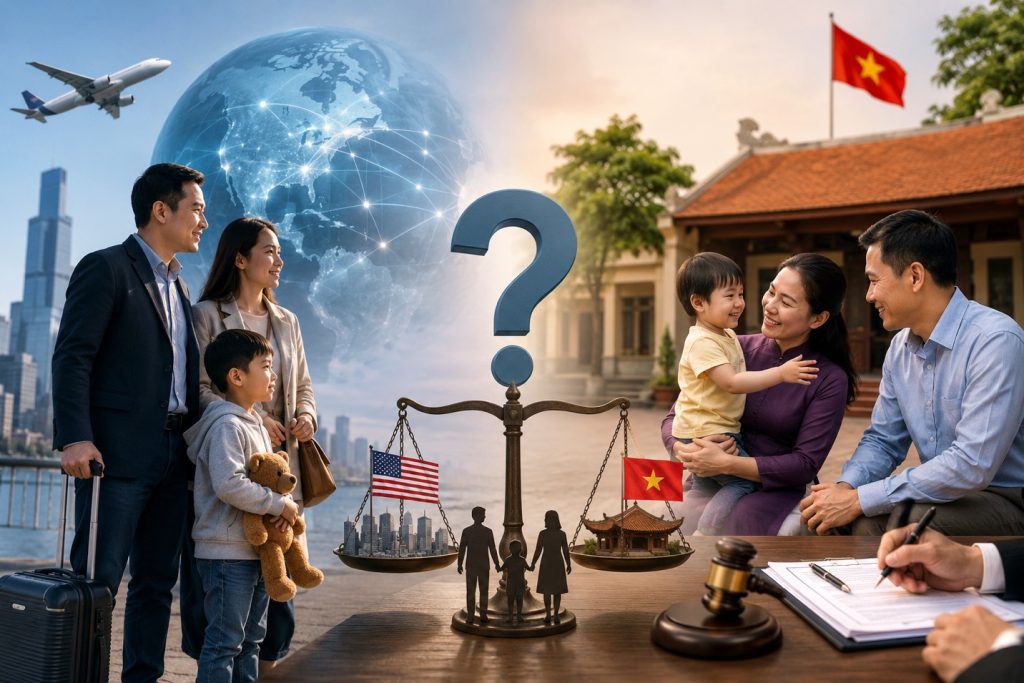
Adoption is a humanitarian legal institution aimed at providing an alternative family environment for children who are unable to receive adequate care and upbringing from their biological parents. In the context of globalization, adoption has increasingly extended beyond national borders and become a legal relationship involving foreign elements.
For Vietnam, the overseas Vietnamese community is substantial in size and dispersed across many countries around the world. Many overseas Vietnamese wish to adopt Vietnamese children in order to maintain a connection with their homeland or to provide children in special circumstances with the opportunity to live in a more stable family environment.
However, allowing overseas Vietnamese to adopt Vietnamese children concerns not only the rights of adoptive parents but also the fundamental principle of ensuring the best protection of the rights and legitimate interests of children. This raises an important legal question: Do overseas Vietnamese have the right to adopt children in Vietnam, and if so, to what extent may that right be exercised?
2. The Concept of Intercountry Adoption
Clause 5 Article 3 of the 2010 Law on Adoption provides that an adoption involving foreign elements is an adoption relationship established between a Vietnamese citizen and a foreign national, or between Vietnamese citizens where one party resides permanently abroad.¹
Accordingly, although an individual may retain Vietnamese nationality, if that person resides abroad and adopts a Vietnamese child, the relationship is classified as an adoption involving foreign elements.
The determination of a “foreign element” is of significant legal importance because the applicable procedures, conditions, and competent authorities differ from those governing domestic adoptions.
3. Are Overseas Vietnamese Entitled to Adopt Vietnamese Children?
3.1. Legal Basis Recognizing the Right to Adopt
Article 28 of the 2010 Law on Adoption expressly provides that overseas Vietnamese are among the categories of persons eligible to adopt Vietnamese children in cases involving foreign elements.²
This provision demonstrates that Vietnamese law does not prohibit overseas Vietnamese from adopting children in Vietnam.
On the contrary, it recognizes such adoption as a legal right intended to create opportunities for Vietnamese children in special circumstances to grow up in a suitable family environment.
However, this right is not absolute and may only be exercised upon satisfaction of strict legal requirements designed to ensure the best interests of the child.
3.2. The Principle of Prioritizing Domestic Adoption
Although overseas Vietnamese are permitted to adopt Vietnamese children, Vietnamese law continues to prioritize finding substitute families within Vietnam before considering intercountry adoption.
This principle derives from the spirit of the United Nations Convention on the Rights of the Child and the objectives of the 2010 Law on Adoption.
Children should, whenever possible, be raised within a familiar cultural, linguistic, and social environment. Only when a suitable domestic adoptive family cannot be found should intercountry adoption be considered.
This mechanism aims to prevent the commercialization of adoption activities and to safeguard the child’s right to comprehensive development.
4. Conditions Applicable to Overseas Vietnamese Adopters
4.1. Compliance with Both Vietnamese Law and the Law of the Country of Residence
Article 29 of the 2010 Law on Adoption provides that overseas Vietnamese adopting a Vietnamese child must satisfy:
- The conditions prescribed by the law of the country where they permanently reside;
- The conditions prescribed by Vietnamese law.³
This is a distinctive characteristic of adoption relationships involving foreign elements.
For example, if a Vietnamese citizen permanently residing in Canada wishes to adopt a Vietnamese child, that person must satisfy not only the requirements of Vietnam’s Law on Adoption but also the legal requirements governing intercountry adoption under Canadian law.
4.2. General Conditions for Adoptive Parents
Pursuant to Article 14 of the 2010 Law on Adoption, an adoptive parent must:
- Possess full legal capacity for civil acts;
- Be at least twenty years older than the adopted child;
- Have adequate health, financial resources, and accommodation to ensure the care and education of the adopted child;
- Possess good moral character.⁴
In addition, individuals whose parental rights are restricted, who are serving prison sentences, or who have criminal records relating to offences against children are not eligible to adopt.
These conditions reflect the principle that the child’s best interests must be the central consideration, rather than merely the wishes of the prospective adoptive parent.
5. Cases of Specific Adoption Designation
A noteworthy feature of the Law on Adoption is the mechanism permitting designated adoptions.
Under Clause 2 Article 28 of the 2010 Law on Adoption, overseas Vietnamese may adopt a specifically identified child in the following circumstances:
- The adopter is the child’s stepfather or stepmother;
- The adopter is the child’s aunt, uncle, or other close blood relative;
- The adopter already has an adopted child who is the biological sibling of the child to be adopted;
- The adopter wishes to adopt a child with disabilities or a child suffering from a serious illness.⁵
This provision demonstrates the law’s preference for preserving existing family or blood relationships whenever possible.
6. Legal Risks and Practical Challenges
6.1. Risk of Abuse of Adoption Procedures
In international practice, there have been cases where adoption procedures were exploited for unlawful purposes, including:
- Child trafficking;
- Illegal transfer of children abroad;
- Profiting from adoption brokerage activities.
For this reason, adoption involving foreign elements is subject to significantly stricter oversight than domestic adoption.
6.2. Difficulties in Monitoring the Child’s Development
Once a child relocates abroad to live with adoptive parents, Vietnamese authorities face considerable challenges in monitoring the child’s actual living conditions.
Therefore, cooperation between Vietnamese competent authorities and the authorities of the receiving state plays a particularly important role.
6.3. Conflicts of Laws Between Different Jurisdictions
Certain countries recognize family structures or adoption arrangements that are not yet recognized under Vietnamese law.
This may give rise to issues concerning the recognition of adoption decisions, the nationality of the child, and the personal rights of the parties involved.
7. Commentary and Recommendations
Allowing overseas Vietnamese to adopt Vietnamese children is both necessary and consistent with the trend of international integration.
However, the ultimate objective of adoption law is not to satisfy the desires of prospective adoptive parents but to ensure the best interests of the child.
Accordingly, the following measures should be considered:
First, mechanisms for verifying the eligibility and suitability of overseas adoptive parents should be strengthened.
Second, international cooperation in monitoring the welfare of adopted children after placement should be expanded.
Third, an integrated electronic database on adoptions involving foreign elements should be developed.
Fourth, legal mechanisms for addressing conduct that exploits adoption procedures for child trafficking or other illicit gains should be further improved.
8. Conclusion
Under the provisions of the 2010 Law on Adoption, overseas Vietnamese are fully entitled to adopt Vietnamese children. However, because such adoption constitutes an adoption relationship involving foreign elements, the adopter must simultaneously satisfy the requirements of Vietnamese law and the law of the country in which he or she permanently resides.⁶
In addition to safeguarding the rights of adoptive parents, Vietnamese law consistently places the best interests of the child at the center of the adoption process. Therefore, intercountry adoption cases must be handled in a strict, transparent, and carefully supervised manner in order to prevent any infringement upon the rights and legitimate interests of children.
📞 CONTACT LEGAL CONSULTANT:
TLA Law is a leading law firm with a team of highly experienced lawyers specializing in criminal, civil, corporate, marriage and family law, and more. We are committed to providing comprehensive legal support and answering all your legal questions. If you have any further questions, please do not hesitate to contact us.
1. Lawyer Vu Thi Phuong Thanh, Ha Noi Bar Association
Email: vtpthanh@tlalaw.vn
2. Lawyer Tran My Le, Ha Noi Bar Association
Email: tmle@tlalaw.vn
Khuong Ngoc Lan