

INTRODUCTION
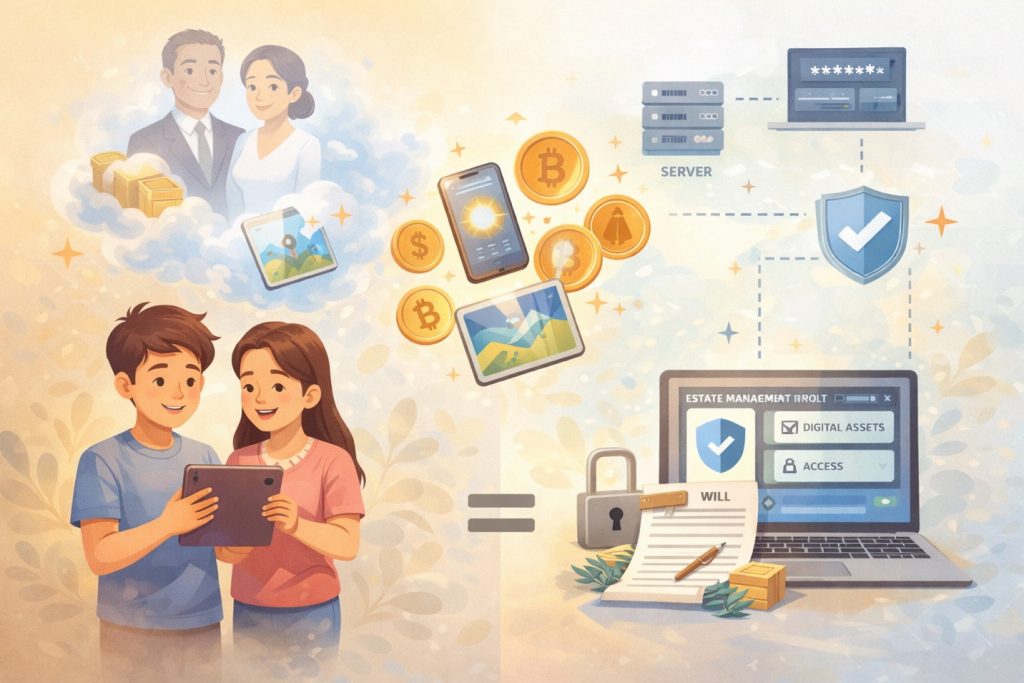
In the context of rapid digital transformation, an individual’s assets no longer exist solely in tangible forms such as money, gold, or real estate, but also include digital assets such as social media accounts, electronic wallets, cryptocurrencies, digital data, gaming accounts, and domain names. However, when the owner passes away, an important legal question arises: Can these digital assets be considered inheritable estate, and if so, how are they managed and distributed under Vietnamese law?
Currently, Vietnamese law does not contain specific and direct regulations governing this issue, resulting in significant legal gaps in practice. Therefore, studying and clarifying this matter is of substantial theoretical and practical importance.
I. CONCEPT OF ESTATE AND DIGITAL ASSETS UNDER VIETNAMESE LAW
1. Estate Under Legal Provisions
Pursuant to Article 612 of the Civil Code 2015:
“Estate includes the separate property of the deceased and the deceased’s share of jointly owned property with others.”
Accordingly, all assets lawfully owned by the deceased may become inheritable estate.
2. Property and Scope of Property Rights
According to Article 105 of the Civil Code 2015:
“Property includes objects, money, valuable papers, and property rights.”
In this context, property rights are understood as rights having monetary value, including rights arising from intangible assets.
This constitutes an important legal basis for determining whether digital assets may be recognized as property under Vietnamese law.
3. Digital Assets – Concept and Classification
Vietnamese law currently does not provide an official definition of “digital assets”; however, they may generally be understood as:
- assets existing in the form of digital data;
- assets capable of ownership establishment, transfer, and valuation.
Examples include:
- bank accounts and electronic wallets;
- cryptocurrencies (Bitcoin, Ethereum, etc.);
- social media accounts (Facebook, TikTok, etc.);
- website domain names;
- economically valuable digital data.
II. CAN DIGITAL ASSETS BE CONSIDERED INHERITABLE ESTATE?
1. Legal Basis for Recognition
Based on the provisions of the Civil Code:
- if a digital asset possesses financial value, it may fall within the category of “property rights”;
- if it lawfully belongs to the deceased, it may constitute inheritable estate.
Therefore, it may be concluded that:
Digital assets may be regarded as inheritable estate provided that they constitute lawful property and are capable of economic valuation.
2. Classification Based on Inheritability
(1) Clearly Inheritable Digital Assets
- electronic wallets and bank accounts;
- e-commerce accounts with monetary balances;
- valuable domain names;
- tradable gaming accounts.
These assets possess clear economic value and may therefore be treated as inheritable estate.
(2) Controversial Categories of Digital Assets
- social media accounts;
- personal email accounts;
- personal data such as photographs and videos.
The legal issue arises because these assets are closely associated with personal rights under Article 25 of the Civil Code 2015 and are not entirely proprietary in nature.
Therefore, they may not be inherited in the same manner as ordinary property, but may instead be addressed from the perspective of management or preservation rights.
(3) Cryptocurrencies (Crypto Assets)
At present:
- Vietnam does not recognize cryptocurrencies as lawful means of payment;
- however, ownership of cryptocurrencies is not prohibited.
Accordingly:
- cryptocurrencies may be regarded as de facto assets;
- nevertheless, inheritance of such assets remains legally problematic due to the absence of a clear regulatory framework.
III. MANAGEMENT AND DISTRIBUTION OF DIGITAL ASSETS AS ESTATE
1. Inheritance by Will
Pursuant to Article 626 of the Civil Code 2015, a testator has the right to:
“Designate heirs and allocate portions of the estate to each heir.”
If the deceased:
- clearly specifies digital assets in the will;
- provides access credentials or relevant information;
then the inheritance process becomes significantly easier.
2. Intestate Succession (Absence of a Will)
In cases where no will exists, Article 651 of the Civil Code 2015 regarding statutory heirs shall apply:
- First line of heirs: spouse, parents, and children;
- Second and third lines of heirs, etc.
However, with respect to digital assets, significant difficulties arise due to:
- challenges in identifying assets;
- difficulties in obtaining access;
- risks of permanent loss caused by missing passwords or private keys.
3. Practical Challenges
- Absence of mechanisms confirming ownership of digital assets;
- Lack of legal provisions regarding posthumous account access rights;
- Dependence on third-party service providers (Facebook, Google, etc.);
- Risk of irreversible asset loss (for example, crypto assets cannot be recovered if private keys are lost).
4. Recommendations for Legal Improvement
- Establish a legal definition of digital assets;
- Officially recognize electronic wills;
- Regulate post-death access rights to digital accounts;
- Develop inheritance management mechanisms for digital assets;
- Refer to international legal frameworks, particularly those of the European Union and the United States.
IV. COMPARISON WITH INTERNATIONAL LAW (BRIEF OVERVIEW)
- United States: Permits management of digital assets through specific legislation such as the Revised Uniform Fiduciary Access to Digital Assets Act (RUFADAA);
- European Union: Protects personal data while allowing conditional inheritance rights;
- Japan: Has begun recognizing digital assets in judicial practice.
Vietnam is currently lagging behind these jurisdictions but possesses substantial potential for future legal development.
CONCLUSION
Digital assets are an inevitable reality in modern society and increasingly constitute a substantial proportion of individuals’ total assets. Although Vietnamese law does not yet contain specific regulations governing this issue, based on the Civil Code 2015, it may be affirmed that digital assets can become inheritable estate if they satisfy the requirements of lawful ownership and economic value.
Nevertheless, the management and distribution of such assets remain challenging due to the absence of a clear legal framework. Therefore, Vietnamese law should be promptly improved to ensure protection of heirs’ legitimate rights while adapting to the continuing development of the digital economy.
📞 CONTACT LEGAL CONSULTANT:
TLA Law is a leading law firm with a team of highly experienced lawyers specializing in criminal, civil, corporate, marriage and family law, and more. We are committed to providing comprehensive legal support and answering all your legal questions. If you have any further questions, please do not hesitate to contact us.
1. Lawyer Vu Thi Phuong Thanh, Ha Noi Bar Association
Email: vtpthanh@tlalaw.vn
2. Lawyer Tran My Le, Ha Noi Bar Association
Email: tmle@tlalaw.vn
Khuong Ngoc Lan